
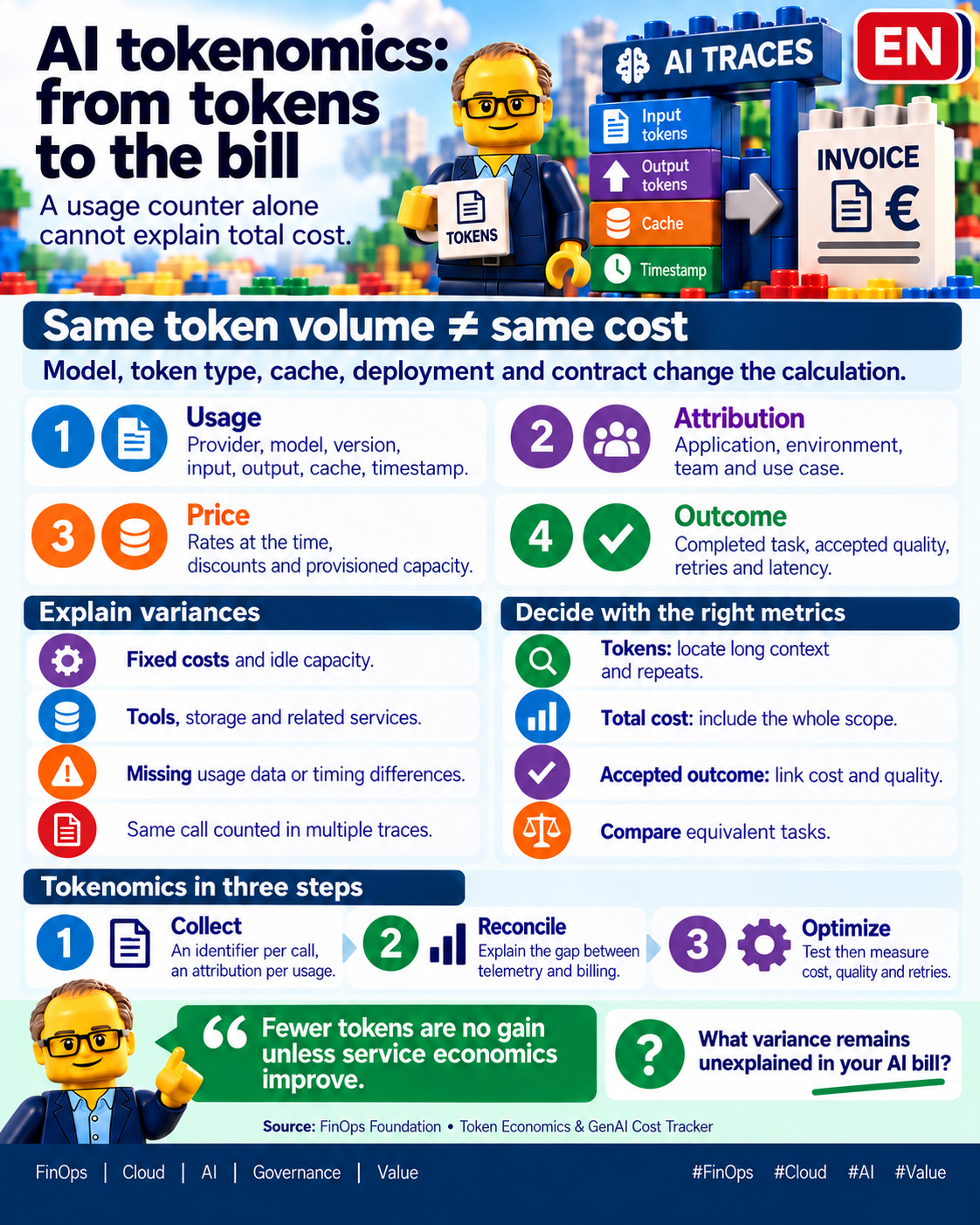
A Token Counter Is Not Cost Reporting
Two applications that consume the same number of tokens can show different costs. The model chosen, the split between input and output tokens, cache usage, deployment mode and applicable pricing conditions all change the calculation. A token counter therefore describes a volume of usage, not an expense.
The metric supports some decisions: a counter can identify changes in consumption, but cannot support budget decisions or architecture comparisons on its own. The first useful workstream is to reconcile application telemetry with the provider invoice, rather than stacking dashboards on a single metric.
Four Elements to Track
Tracking can be organized into four areas. The first is usage: provider, model and version, input tokens, output tokens, cache, timestamp. Without the model version, a comparison over time loses part of its meaning, since the same call may not be billed the same way depending on the version served.
The second is attribution: application, environment, team and use case. This block is what makes cost actionable, because it links an expense to an owner and a need. Approximate attribution produces approximate trade-offs.
The third is price: rate applicable to the period, discounts and possibly provisioned capacity. A cost calculated with an outdated rate, or while ignoring already paid capacity, describes a reality that no longer exists. The fourth is outcome: task completed, quality accepted, retries and completion time. Without this dimension, a volume is optimized without knowing whether the service delivered has remained the same.
Three Controls to Avoid False Savings
The first control concerns duplicates: the same call can be recorded both in the gateway and in application traces. Adding them together amounts to counting the same expense twice and producing a fictitious saving as soon as one of the two paths is corrected.
The second control consists of explaining discrepancies with billing. Fixed costs, ancillary tools, storage and missing usage data can create a discrepancy that has nothing to do with a consumption drift. An unexplained discrepancy is not a saving; it is an uncertainty.
The third control is comparability: two configurations can be compared only on identical quality and scope. Simultaneously changing the model, context length and functional scope makes attribution of the gain impossible.
What Granularity Makes It Possible to Locate
Granularity at the token level is used first to locate a drift: context too long, unnecessary output, repetitions in exchanges. These three causes do not have the same remedies and are not detected at the level of application-level cost totals.
Reducing tokens while increasing retries can raise the cost of the service. A shortened prompt that forces the user to rephrase, or that triggers a second attempt, shifts the cost rather than eliminating it. A drop in token volume is therefore not, in itself, an indicator of progress.
Fully Loaded Cost per Accepted Outcome
Fully loaded cost per accepted outcome helps decide whether an optimization creates value. It is a more demanding criterion than cost per token, because it incorporates retries and quality. A model that is cheaper per token can cost more per successful task if it fails more often or requires more corrections.
This criterion requires defining what an accepted outcome is, and by whom. This definition is a management choice as much as a technical measurement: it varies by use case and must remain stable over time for comparisons to hold.
Questions to Settle Before Industrializing
Several points remain open. What discrepancy remains unexplained between AI traces and the invoice, and how often is this reconciliation redone? Who owns the definition of accepted quality, and how is it controlled? How should calls recorded by several technical layers be handled without counting them twice?
The references published by the FinOps Foundation, consulted on 24 September 2026, provide a methodological framework for this type of tracking. They do not, however, validate the figures of a particular case: each organization must establish its own reconciliation between telemetry and billing, with its own scope and rates.
The post behind this insight
Expanded from the LinkedIn post. The links below come from the original post; listing them does not imply independent verification.
LinkedIn ↗