
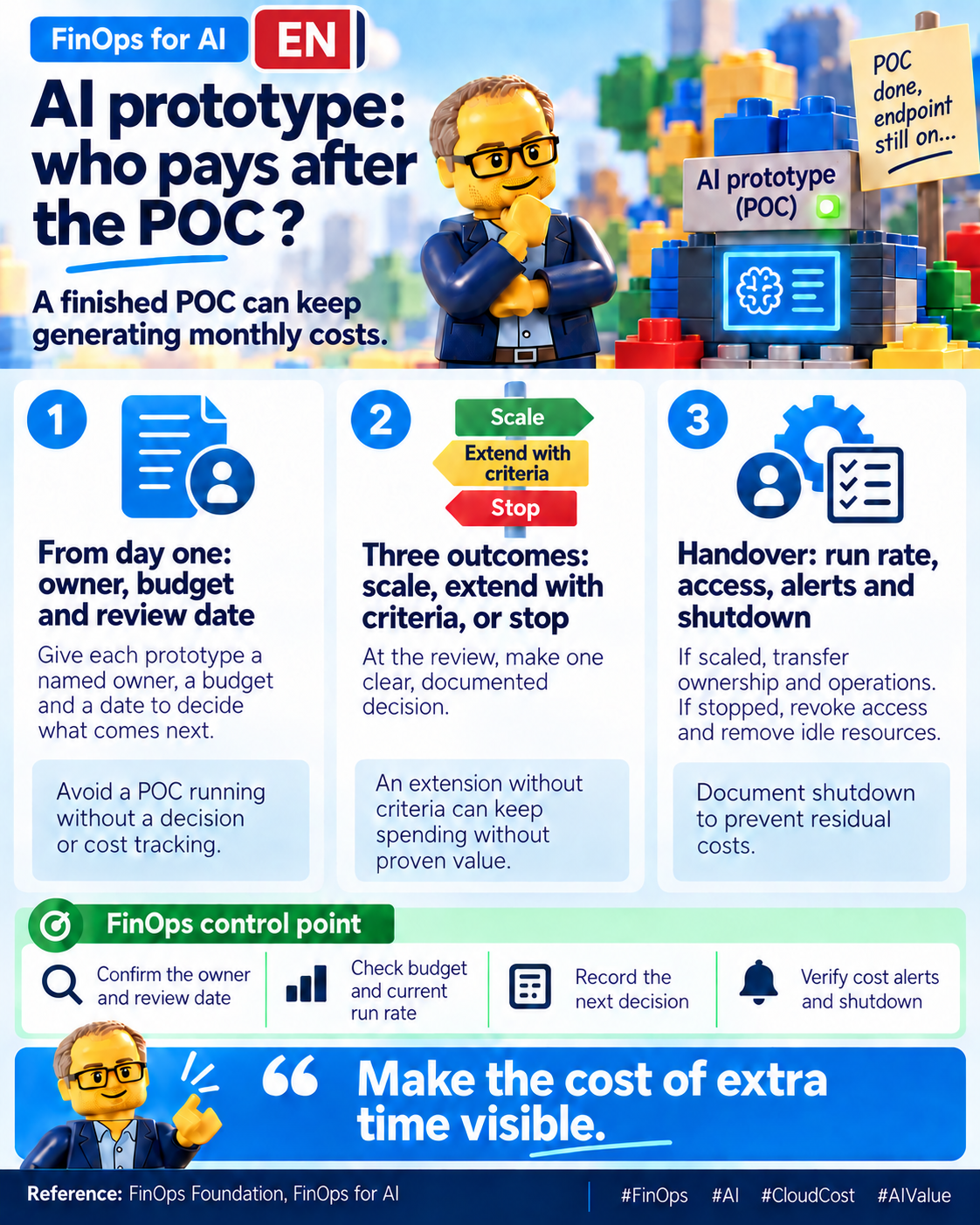
A finished POC, a service still active
An artificial intelligence proof of concept rarely concludes with a clean shutdown. The experiment ends with a demonstration, a shared conclusion or an exhausted budget, but the endpoint keeps running. And as long as it runs, it bills.
This gap is easy to miss. No one receives an alert the day the prototype loses its meaning. The service remains active through inertia, and its cost blends into a broader billing line, without anyone having explicitly decided to keep it alive.
The accountability gap between experimentation and production
Between experimentation and production, an accountability gap can appear. During the testing phase, a team is mobilized, a sponsor follows the topic, questions are asked regularly. Once the POC is finished, attention shifts to other priorities. No one owns the budget anymore, the service remains active, and its value is no longer measured.
The problem is not primarily technical. It is organizational: the end of a POC is not an automatic event, and nothing stops a service by default. Without an explicit decision, the status quo sets in, with a recurring cost no longer tied to an objective.
Three explicit outcomes rather than a status quo
One possible approach is to set a review date from the start of the prototype, with three explicit outcomes: industrialize the solution, extend it with a budget and clear criteria, or stop it and remove the resources.
Each of these outcomes has its implications. Industrializing assumes an owner, a production framework and an identified value. Extending assumes defining in advance what would justify a new period: which uses, which expected results, which acceptable cost. Stopping assumes owning a decision that is often uncomfortable, but that avoids indefinitely financing a service without use.
The key point is that the absence of a decision is not neutral: it amounts to extending without criteria. Setting the review date at the beginning, rather than at the end, prevents the question from being postponed to the moment when attention has already dissipated.
The handover: code, data, owner, recurring cost, alerts, shutdown
A structured handover should cover several elements: the code, the data, the designated owner, the recurring cost, alerts and the shutdown procedure.
Code and data determine what can be taken over or archived. The owner answers the question “who decides?”. The recurring cost, often expressed as monthly or annual spend, makes visible what keeping the service running commits. Alerts make it possible to detect drift, for example consumption that increases without associated usage. The shutdown procedure avoids orphaned resources, those components that keep running because no one knows how to turn them off cleanly.
Without these elements, the decision to continue or stop remains difficult to make, for lack of shared information.
The role of FinOps: make cost visible, not decide alone
FinOps should not decide alone whether a product deserves to continue. Its contribution is to make visible the cost of additional time, so that the right people can decide with full knowledge.
This distinction is important. Cost is data, not a verdict. A service can cost a lot and create a lot of value, or cost little and serve no one. The decision to continue is a product and business judgment, informed by the figures. Confusing the two roles leads either to purely budgetary trade-offs or to an extension without regard for the resources committed.
Who should stop a POC that never reaches production?
The question remains open: who is responsible for stopping an AI POC that never reaches production? Depending on the organization, the answer can vary: the owner designated during the handover, the sponsor who carried the experiment, or a product body that arbitrates priorities.
The essential thing is that the answer is known before the end of the POC, and not discovered after the fact. Clear governance, a review date and a documented handover transform costly inertia into an assumed choice. The question to ask is not only “how much does it cost?” but “who decides, and on what criteria?”.
The post behind this insight
Expanded from the LinkedIn post. The links below come from the original post; listing them does not imply independent verification.
LinkedIn ↗