
The trade-off: cold start versus idle capacity
A cold start can degrade user experience: the first invocation of a function waits for the execution environment to be created before processing the request. Conversely, keeping capacity ready at all times has a cost, including while it is not being used. This is the central trade-off described in the AWS documentation on Provisioned Concurrency.
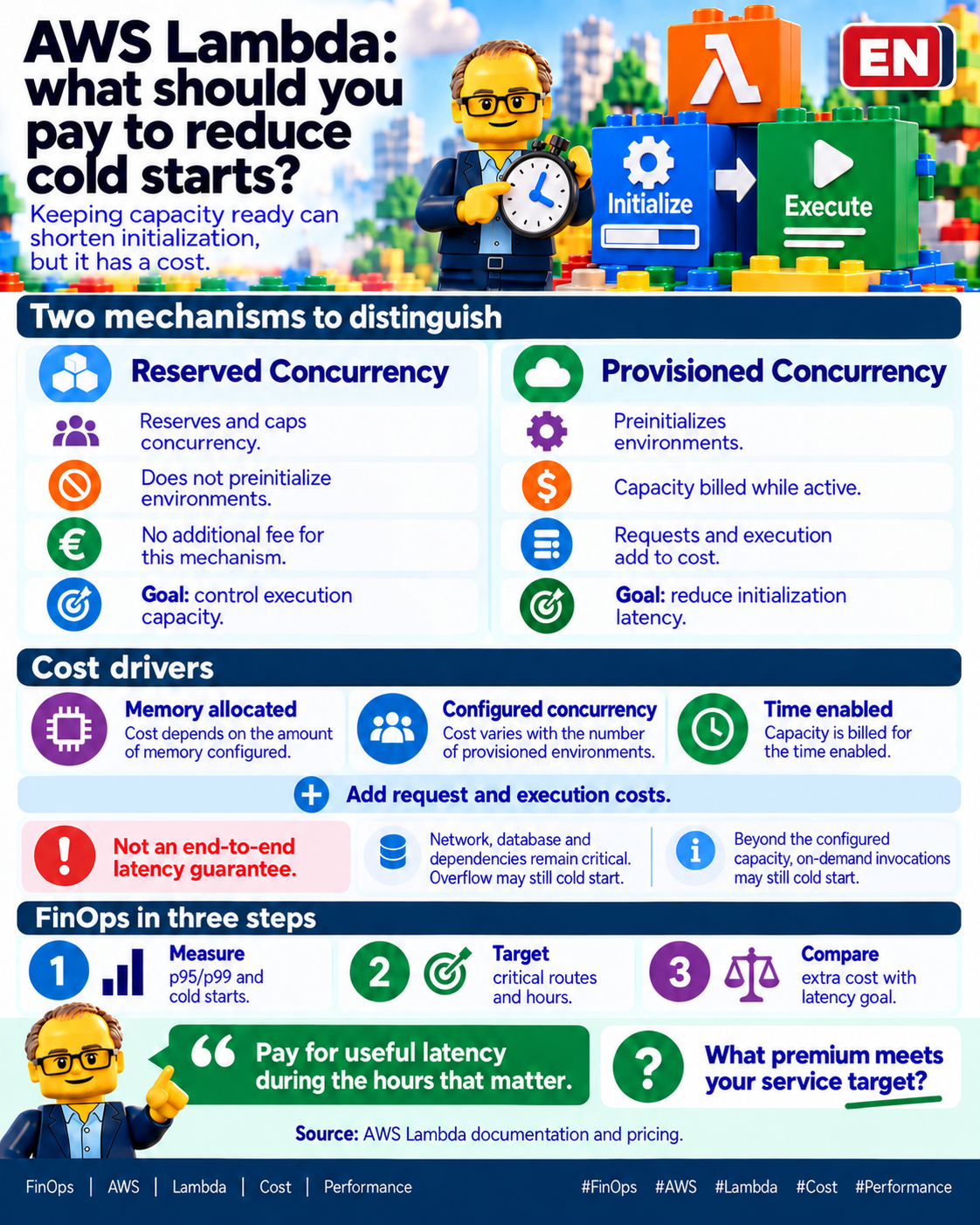
Provisioned Concurrency preinitializes execution environments for a Lambda function. The goal is to reduce initialization time at invocation, particularly for latency-sensitive workloads. It is neither a free setting nor an absolute guarantee: it is reserved and billed capacity.
What billing covers
Provisioned Concurrency billing depends partly on configured memory, provisioned concurrency and the duration for which it is enabled. The usual Lambda request and execution charges are added to this. In other words, the cost is not limited to idle capacity: every invocation continues to be billed under the standard rules.
This cost structure requires reasoning in three dimensions: how much memory per environment, how many simultaneous environments, and for how long. Capacity provisioned continuously over twenty-four hours does not have the same profile as capacity enabled for a few hours a day. The AWS documentation and pricing consulted on 24 September 2026 are the reference to check, because prices and terms can change.
A partial latency guarantee, not end-to-end
Provisioned Concurrency does not guarantee end-to-end latency. It acts on execution environment initialization, but the database, network and external dependencies remain on the critical path. A request can therefore remain slow even with preinitialized environments if a downstream call slows down.
Moreover, invocations that exceed provisioned capacity can be served by on-demand capacity. In that case, a cold start remains possible. Provisioned capacity is therefore not an unlimited absorption ceiling: beyond the configured level, behavior returns to that of a standard Lambda function.
Reserved Concurrency: another mechanism
Provisioned Concurrency and Reserved Concurrency should not be confused. Reserved Concurrency reserves and caps a function's concurrency, without preinitializing environments. It is used in particular to ensure that a function has a concurrency quota and to prevent it from consuming the account's entire shared quota. Provisioned Concurrency, by contrast, targets initialization time. The two mechanisms address different problems and can have distinct cost implications.
Five steps before enabling
Before enabling Provisioned Concurrency, several steps can ground the decision. First, measure p95 and p99 latencies, and the share of those latencies attributable to initialization. Second, identify latency-sensitive user journeys and the hours that actually matter. Third, size capacity from observed concurrency, not from intuition. Fourth, monitor provisioned capacity utilization and overflows to on-demand capacity. Fifth, compare the additional cost with the number of requests that actually meet the latency objective.
This last comparison is decisive: paying for provisioned capacity makes sense only if a sufficient volume of requests benefits from it. Largely underused capacity or frequent overflow signals that sizing needs to be reviewed.
Not all workloads are equal
An asynchronous process that can wait a few seconds is not framed in the same terms as a critical customer interaction. For a background job, the cost of permanent provisioned capacity is difficult to justify if the user does not perceive the latency. For a customer interaction, the trade-off may be different.
One possible approach, as an illustration and not a universal recommendation, is to enable Provisioned Concurrency only during peaks, while working on initialization optimization. Reducing initialization time, for example by lightening dependencies or adjusting memory, can reduce the need for provisioned capacity. These avenues must be validated by measurements specific to each function.
Decide on measurements before and after
The decision should rest on measurements before and after enabling. Without comparison, it is difficult to know whether the target latency is reached, whether capacity is correctly sized and whether the extra cost translates into a measurable benefit. The figures to track include latency percentiles, the initialization share, provisioned capacity utilization, overflows and total cost.
The question to ask therefore remains: what additional amount is one prepared to pay to reach the latency objective, and for which hours? The answer depends on the journeys concerned, the request volume and tolerance for waiting. It cannot be deduced from a default setting.
The post behind this insight
Expanded from the LinkedIn post. The links below come from the original post; listing them does not imply independent verification.
LinkedIn ↗