
The scope of the incident reported by Reuters
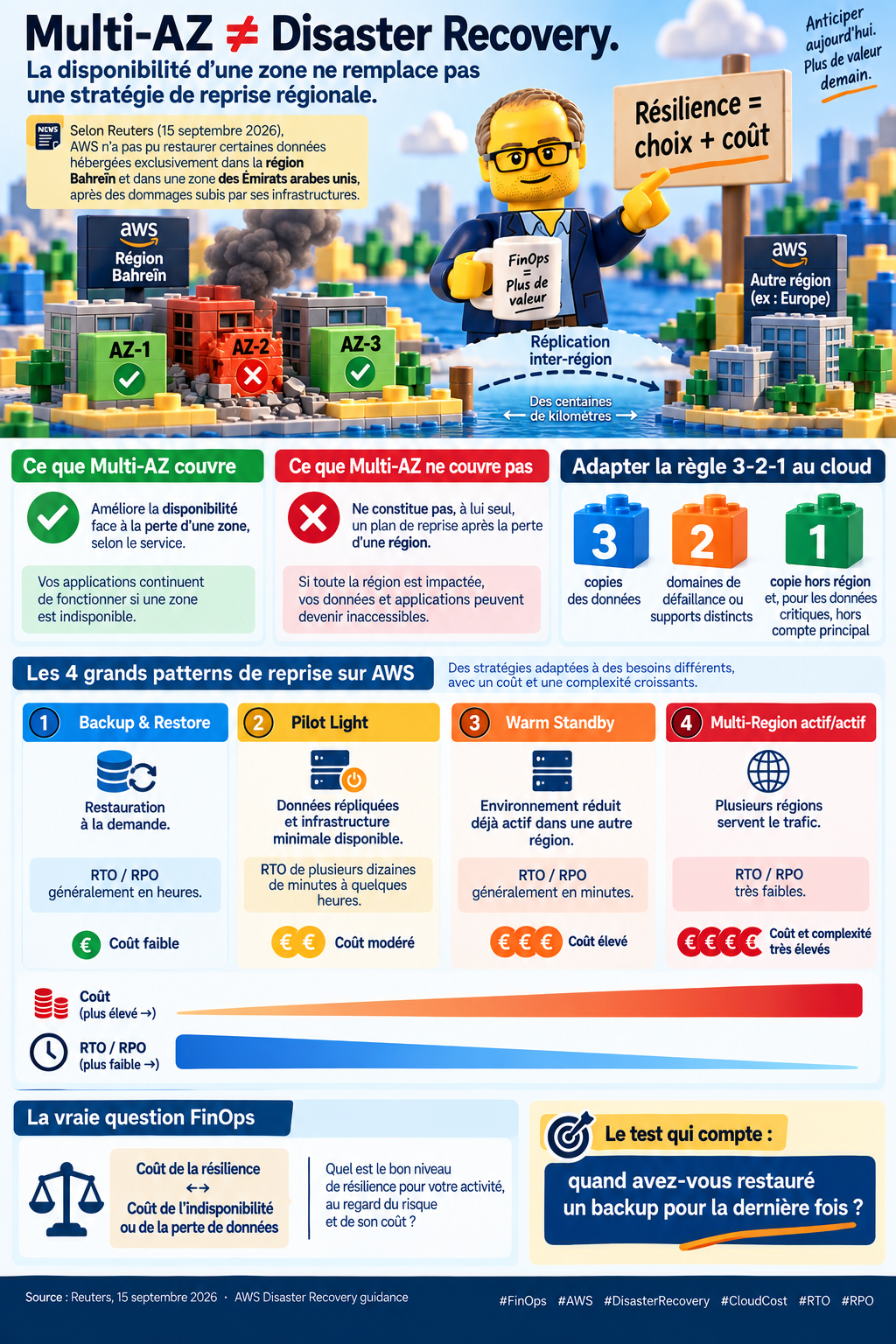
According to Reuters, in an article dated 15 September 2026, AWS indicated that it could not restore certain data hosted exclusively in the Bahrain region and in one zone in the United Arab Emirates, following damage to its infrastructure in 2026. This information remains attributed to Reuters and is not independently verified here.
Scope matters: the account concerns certain data hosted exclusively in the affected locations. It does not establish that all data in those regions was lost. It prompts checking where the copies supporting your own recovery reside.
For each application, specify the failure scenarios covered. Losing a zone, losing a region or encountering a problem with the primary account does not necessarily require the same organization of backups and recovery resources.
Distinguish availability from recovery after losing a region
Depending on the service, Multi-AZ improves availability when an availability zone is lost. This protection addresses a local scenario. On its own, it is not a recovery plan for losing a region.
The recovery plan needs to identify recoverable data, its location and the steps needed to restore the service. Objectives for recovery time and acceptable data loss need to be agreed with business owners.
RTO and RPO express these objectives: the target recovery time and acceptable data loss. They need to be specified per application and compared with tested capabilities. A documented objective is insufficient to demonstrate it can be met.
Adapt the 3-2-1 rule to failure domains
The 3-2-1 rule originated in backup practice. A cloud adaptation may use 3 copies of the data, 2 distinct failure domains or media, and 1 copy outside the region. For critical data, that last copy may also be outside the primary account.
Map the copies and understand what could make them unavailable together. Copy count alone does not describe their separation. Check regions, accounts and the procedures for accessing backups during recovery.
This adaptation is a design suggestion to adjust to your obligations and risk scenarios. Its cost needs to include additional storage, required transfers and the work of preparing and checking restores.
Compare the four recovery patterns
AWS presents four major patterns. Backup & Restore relies on on-demand restoration, with RTO and RPO generally measured in hours. Backups and reconstruction steps need to be included in the recovery test.
Pilot Light keeps replicated data and minimal infrastructure available. The stated RTO ranges from tens of minutes to a few hours. Plan how this infrastructure will be expanded when recovery is triggered.
Warm Standby runs a reduced version of the environment in another region. RTO and RPO are generally measured in minutes. Cost needs to include this secondary capacity and its preparation for the expected load.
In Multi-Region active/active, several regions serve traffic. Target RTO and RPO are very low, with high cost and complexity. These orders of magnitude remain indicative: results depend on the application, data and tested procedures.
An organization can select different patterns according to application criticality. Compare each option with the actual need, including dependencies that must also work during recovery.
Measure cost and test the restore
The FinOps trade-off compares the cost of the requested resilience level with the estimated cost of downtime or data loss. Price copies, transfers, the secondary environment and tests. Have the relevant teams agree on the need and budget.
As a starting approach, inventory applications and critical data, document RTO and RPO, then check out-of-region copies and, for critical data, out-of-account copies. Select a pattern compatible with these objectives and schedule an exercise.
During restoration, check recovered data, executed steps and actual timing. Record gaps against the plan and corrective actions. The next exercise should verify those corrections, then adjust the budget and procedures if requirements have changed.
The post behind this insight
Expanded from the LinkedIn post. The links below come from the original post; listing them does not imply independent verification.
LinkedIn ↗