
What the notice says, and what it does not say
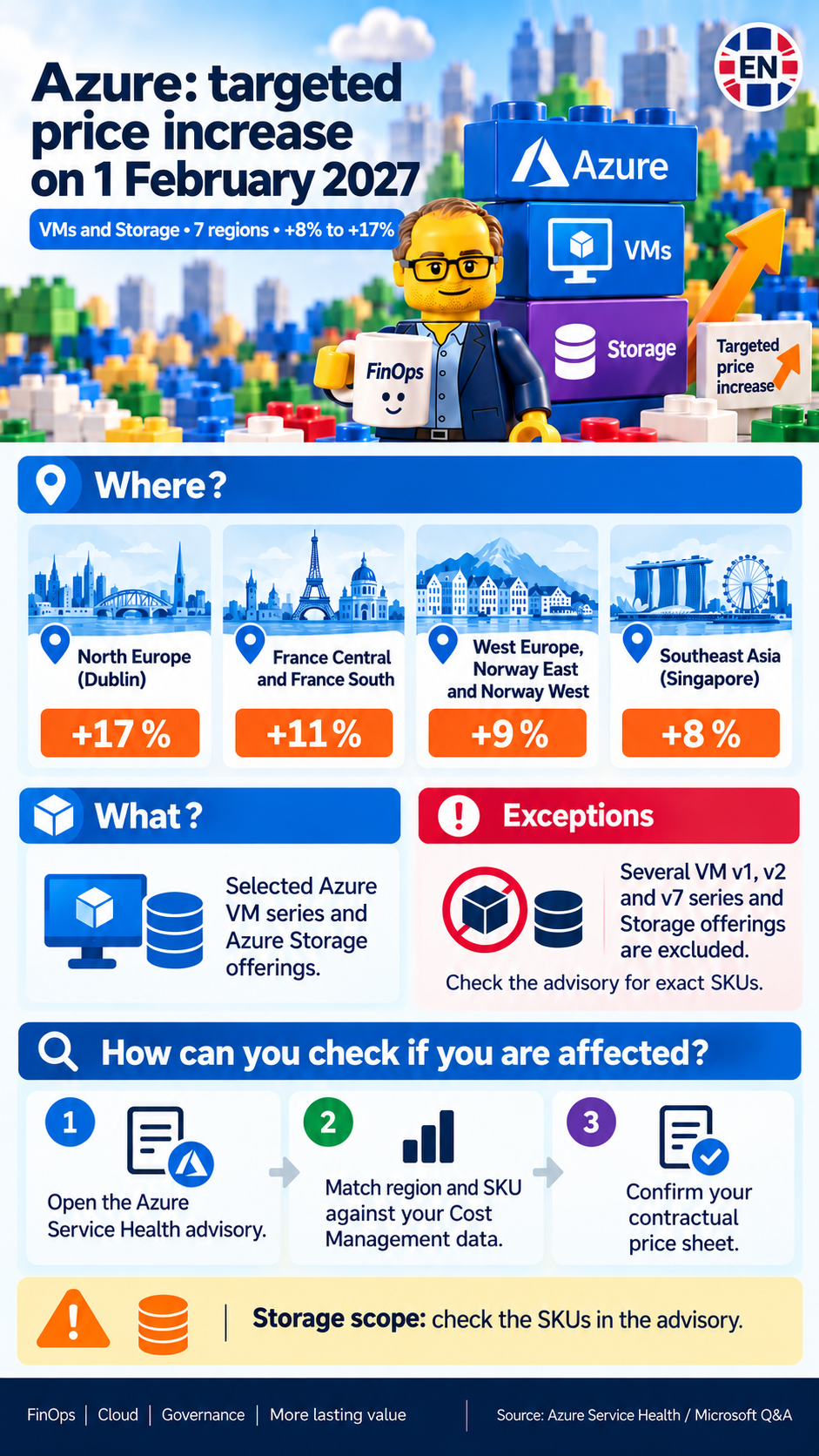
The Azure Service Health notice reports a price increase on 1 February 2027 for certain Azure VM and Storage offerings across seven regions. The range stated in the notice is 8% to 17%. These figures come from the notice and are not independently verified here.
The rates stated by region are: North Europe (Dublin) +17%; France Central and France South +11%; West Europe (Amsterdam), Norway East and Norway West +9%; Southeast Asia (Singapore) +8%.
Access to the notice requires sign-in, according to the source. The first step is therefore not an analysis, but documentary access and extraction of the impacted-resource list. A notice of this kind gives a rate and a scope; it does not give your actual exposure, nor the split of your consumption between in-scope and excluded SKUs.
VM exclusions: read the series, not just the region
Scope depends on the SKU as much as on the region. The following VM series are excluded from this regional increase: v1 — Bv1, D, Ds, F, Fs, G, Gs, L, NP, HCS; v2 — Av2, Amv2, Dv2, Dsv2, Fsv2, Lsv2; v7 — Dsv7, Ddsv7, Dlsv7, Dldsv7, Esv7, Edsv7.
Practical consequence: two resources in the same region may react differently. An 11% increase in France Central is not an 11% increase on your VM bill; it is an 11% increase on the non-excluded SKUs you actually consume there.
The useful reasoning therefore starts from the SKU and the region, then cross-checks with consumption. The main criterion is exposure: the share of consumption located in the seven regions, and the share of that consumption carried by in-scope SKUs.
Storage: a list of exclusions, but not a complete list of increases
For Storage, the exclusions listed in the notice are: Azure Container Storage, Azure Managed Lustre, Azure NetApp Files (Cross Region Replication), Blob Features, Change Feed, General Block Blob, Import/Export, Queues, Queues v2, Standard Page Blob, Storage Actions, Storage Bandwidth, Storage Discovery, Tables and the Transaction Optimized SKU.
Important caveat: the notice does not list every Storage SKU whose price will rise. A Microsoft Q&A answer on 5 October stated that no detailed public article existed at that point. This is a point of vigilance: the absence of a SKU from the exclusion list does not prove it is exempt.
This asymmetry between a precise exclusion list and an incomplete increase list is what makes Storage costing fragile. It justifies seeking clarification from Microsoft or a partner before finalising a forecast.
Decision criteria and tradeoffs
The criteria to combine are: the effective date of 1 February 2027; each resource's region; the exact SKU; the share of consumption affected; any contractual price protection or indexation mechanism in the price sheet; and the treatment of ambiguous Storage offerings.
The tradeoff concerns the level of precision. An estimate based on an average regional rate is quick, but may overestimate or underestimate the effect depending on your SKU mix. A line-by-line, SKU-by-SKU estimate is more reliable but more time-consuming. An intermediate approach is to cost the confirmed in-scope SKUs, then isolate the rest in an explicit uncertainty envelope.
Another tradeoff concerns the horizon: the increase is dated 1 February 2027, but an annual budget forecast must also account for volume changes, new deployments and resources that may be migrated or resized by then.
Questions to ask before costing 2027
Is my exact SKU, in my region, within the scope of the increase?
Which exact Storage offerings are affected, at SKU level, and not only at service-family level?
Does the contractual price sheet provide price protection or an indexation mechanism before renewal?
Does the increase apply to existing resources, to new deployments, or to both?
From which billing date does the effect become visible?
These answers directly shape the forecast. In their absence, documenting the assumptions used, with their level of confidence, is the only defensible option.
Suggested checklist (hypothetical example, to be adapted)
This list is a suggested method, not a prescription. It assumes you have access to the notice and to Cost Management.
Open the Service Health notice and the Impacted Resources tab. Export the resulting list. Cross-check that list with Cost Management, by SKU and by region. Also check your own resource inventory: the tab may miss resources.
Tag the in-scope SKUs and the excluded series. Ask Microsoft or your partner about any ambiguous Storage offering. Update the 2027 forecast by applying the regional rate only to in-scope consumption, not to the total bill.
Finally, run a sensitivity test at 8%, 11% and 17% depending on the regions concerned, to see how the budget reacts at the low and high ends of the stated range.
What this changes for an Azure budget
The budget effect is the product of in-scope consumption and the applicable rate. It is not a percentage applied to the total bill. If your excluded series dominate your consumption in these regions, the impact may remain limited; if it relies on non-excluded SKUs in North Europe, the effect may be more pronounced.
The main uncertainty remains Storage, for lack of a complete list of affected SKUs. The useful question is therefore not only “by how much is the price rising?”, but “what share of my consumption is actually exposed, and from when?”
For a 2027 budget, the value of a forecast lies less in its exact figure than in the traceability of its assumptions: scope, rates, volumes and identified uncertainties.
The post behind this insight
Expanded from the LinkedIn post. The links below come from the original post; listing them does not imply independent verification.
LinkedIn ↗