
A structured output for a specific decision
Routing a ticket, classifying an ad or filtering a page sometimes requires a decision in a known format. A long generated answer can add extraction work without meeting a writing need. The expected output should therefore be defined before choosing the model.
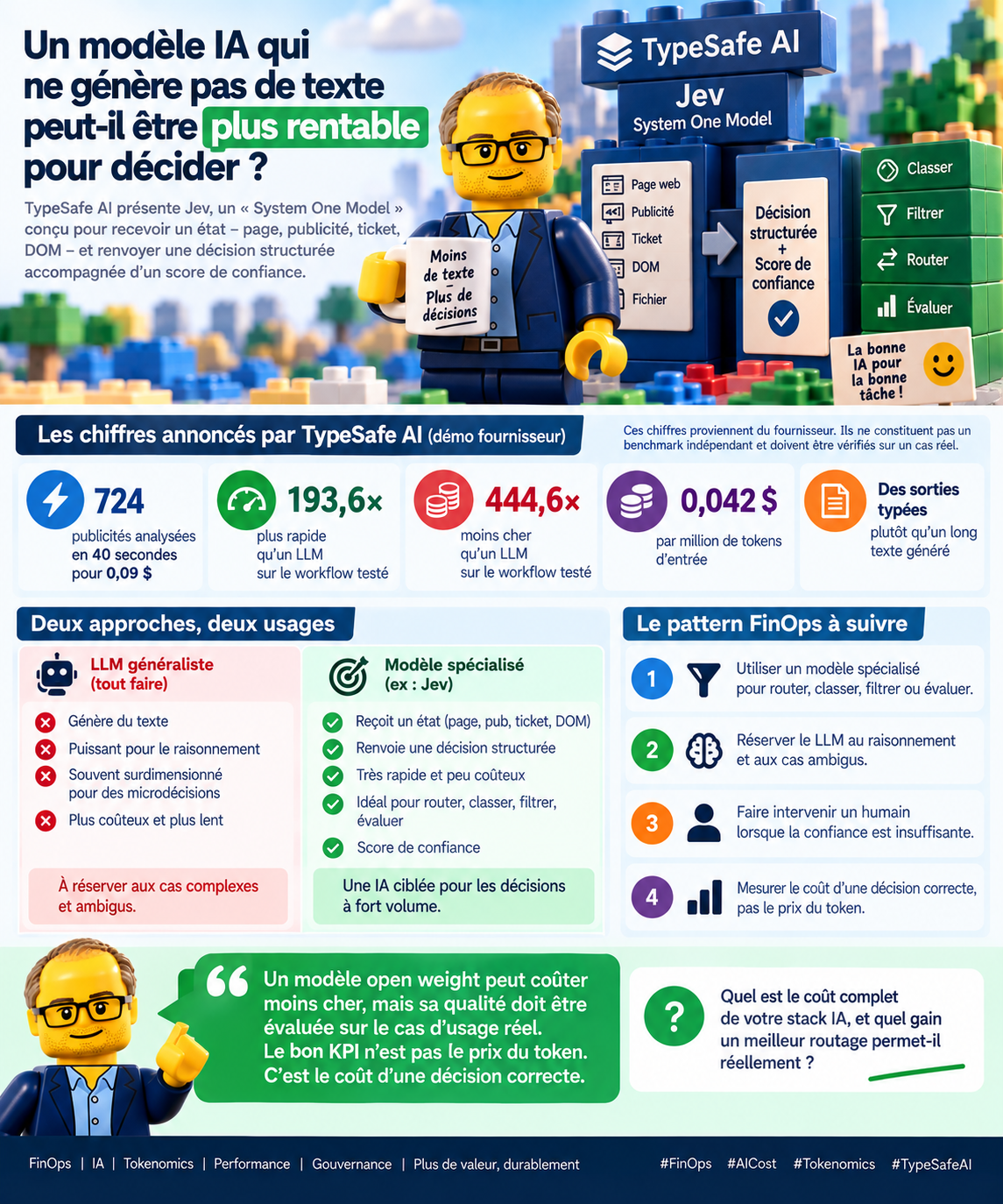
TypeSafe AI presents Jev as a “System One Model” that receives a state, such as a page, an ad, a ticket or a DOM, then returns a structured decision with a confidence score. The announced outputs are typed. This approach is worth assessing for repeated microdecisions within a workflow.
The choice depends on the work required. A specialized model can support routing, classification, filtering or evaluation. Reasoning and ambiguous cases can remain with an LLM. The boundary between these uses needs to be defined using representative examples.
TypeSafe AI’s figures and their scope
In its demonstration, TypeSafe AI claims 724 ads analyzed in 40 seconds for $0.09. The vendor reports a workflow 193.6 times faster and 444.6 times cheaper than an LLM on the tested case, along with a rate of $0.042 per million input tokens.
These figures come from the vendor and are not an independent benchmark. The claimed improvement concerns the tested workflow. Before using it in a budget estimate, check the input data, comparison model and criteria used to accept a decision.
The test also needs to state what it includes: model calls, input preparation, output processing and exception handling. A comparison that omits some of these costs may overstate a solution’s value. The claimed multipliers do not guarantee the same result in your environment.
Calculate cost per correct decision
Token price describes a rate. To assess the workflow, I would use cost per correct decision: total spending over a defined scope, divided by the number of decisions accepted as correct. This requires a shared definition of correctness.
The calculation needs to include retries after failure, output processing, corrections and human time spent on exceptions. A model that is cheap per call may lose its advantage if its responses require more rework.
Business rules, a specialized model and a generalist LLM can then be compared on the same cases. Rules may suffice where the decision is already explicit. Models need to be assessed where their capabilities deliver a useful result, against the same quality requirements.
Plan how uncertain decisions will be handled
The confidence score can help route cases to automated processing or human review. Insufficient confidence should trigger a planned process, with an owner able to examine the decision. The threshold does not replace measuring observed errors.
Track how many decisions go to review, how many are corrected and how much effort that review requires. A cautious threshold may increase human workload; an overly permissive one may allow more errors through. The setting needs testing on your use case.
Ambiguous cases can also be routed to an LLM before human intervention. This is a design option to compare, accounting for final quality, delay and the cumulative cost of that route.
Build a comparable pilot
Start by selecting a microdecision and defining its output format, volume and error tolerance. Assemble a representative sample of your inputs, with reference decisions and a process for resolving disagreements.
On that same sample, measure quality, processing time, exceptions and the full cost of the selected options. Document the confidence threshold and the scope assigned to the LLM. These are methodological suggestions, not a product validation.
After the pilot, retain the data supporting the choice and plan periodic reviews. Changes in volume, input type or pricing can alter cost per correct decision and lead to revised routing.
The post behind this insight
Expanded from the LinkedIn post. The links below come from the original post; listing them does not imply independent verification.
LinkedIn ↗